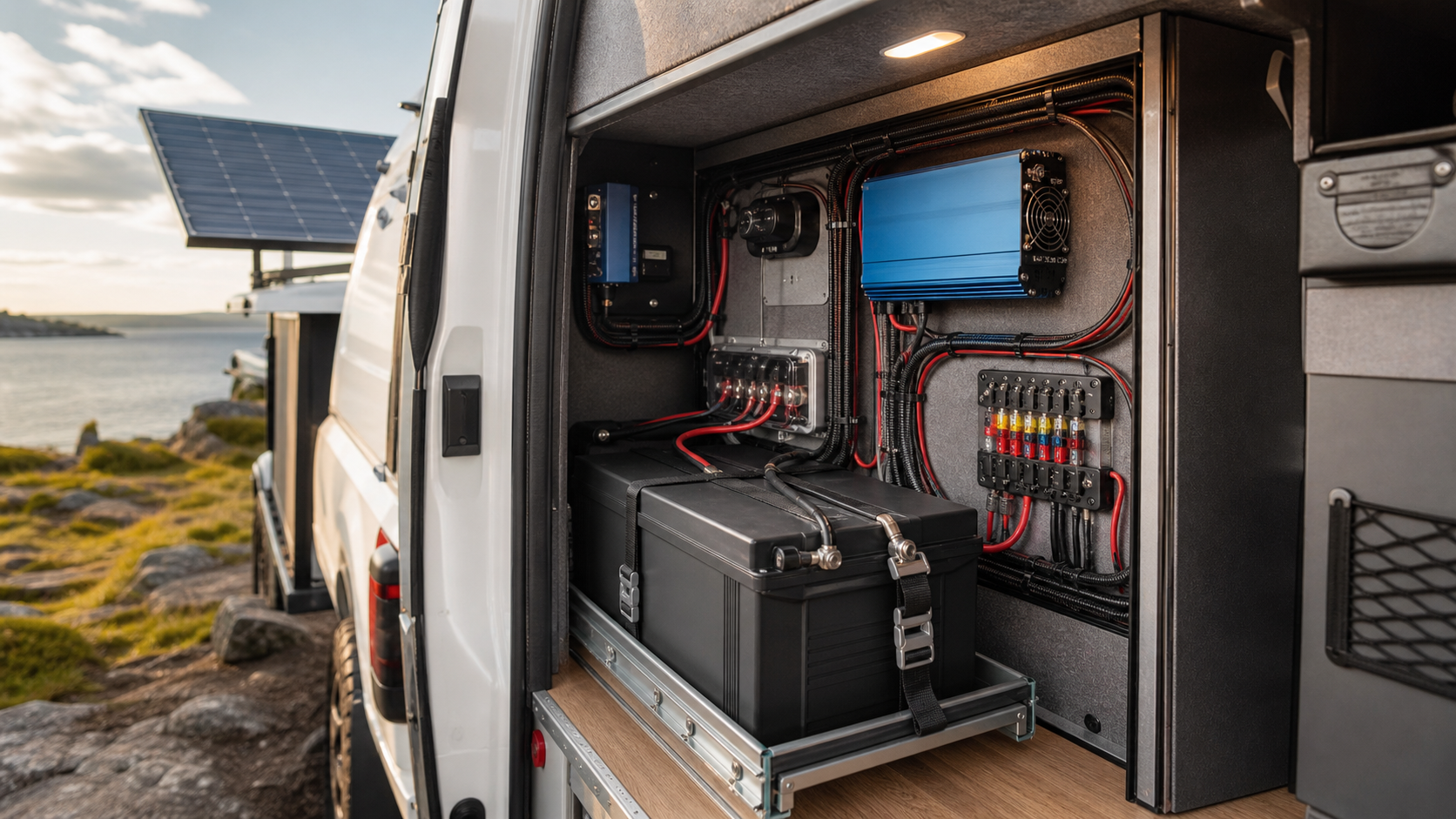
Campervan electrics feel complicated when they look like one large bundle of wires. In practice, the system is easier to understand in three parts: where energy is stored, where it is charged from and which appliances consume it. Once those blocks are clear, choosing a battery, solar panel and inverter becomes less like guessing.
Energy storage is the leisure battery. It is separate from the vehicle starter battery so the fridge, lights and water pump do not leave the engine unable to start in the morning. Older or budget builds often use AGM or gel batteries; modern systems increasingly use LiFePO4 lithium. Lithium is usually lighter, can use more of its capacity and charges faster, but it needs suitable charging equipment and protection.
Charging usually comes from three sources. The first is the engine through a DC-DC charger, which safely moves energy from the alternator to the leisure battery. The second is a solar panel through a solar charge controller. The third is shore power at a campsite through a mains charger. A good system may use all three, but each charger must match the battery type.
A solar panel does not make a campervan fully independent by itself. It only refills the battery, and the result depends on season, weather, shade, panel angle and real consumption. In summer on an open pitch, solar can help the fridge and lights run longer without a hookup. In winter, forest shade or cloudy weather, its contribution may be modest, so calculations should include margin.
An inverter is only needed for appliances that require household AC power, such as some laptops, chargers, kitchen appliances or tools. It turns battery energy into AC power, but it creates losses and needs heavy wiring. If a device can run from 12 V or USB-C, direct power is often more efficient than using an inverter.
The most useful habit is calculating consumption in watt-hours. A fridge, light, pump, fan, laptop and heater all draw different power and run for different amounts of time. Multiply each appliance's watts by the hours it runs per day, then add the results. That tells you whether the battery is enough for one night, two days away from hookup or only an evening.
Safety matters more than an attractive control panel. You need fuses near energy sources, correct cable sizing, secure connections, ventilation for components and clear labeling. AC systems, shore-power connections and complex lithium installations should be designed or checked by a qualified specialist. Good campervan electrics should not be surprising; they should work calmly every day.
Source: camperhub.io